Solo RPG: The Librarian's Apprentice by Daniel Bronson-Lowe
You can find a physical copy of The Librarian’s Apprentice in your FLGS, or online directly from the author. (They even published a sequel!)
I grew up all around books. My parents had a sizeable collection, as did my grandparents and a number of my other family members. Each focused on their own fields of study or interests, which introduced a lot of variety to my early reading. Safe to say, I think each of them had a room dedicated to books, or at least a large bookshelf in every room of their home, so that you’d never find yourself more than a few steps away from reading material. I certainly have fantasized about living in a library, and with a fantastical twist, I get to think about just that through the medium of today’s game, The Librarian’s Apprentice.
Quick Facts
Number of games played: 2.
Time per session: ~2.5-3h
Items used to play: 2D6, deck of cards, pen & paper, token
Three words on how it made me feel: artistic, focused, tired
Did I have fun: yes, but had to take breaks.
Would I play it again: yes.
How to Play
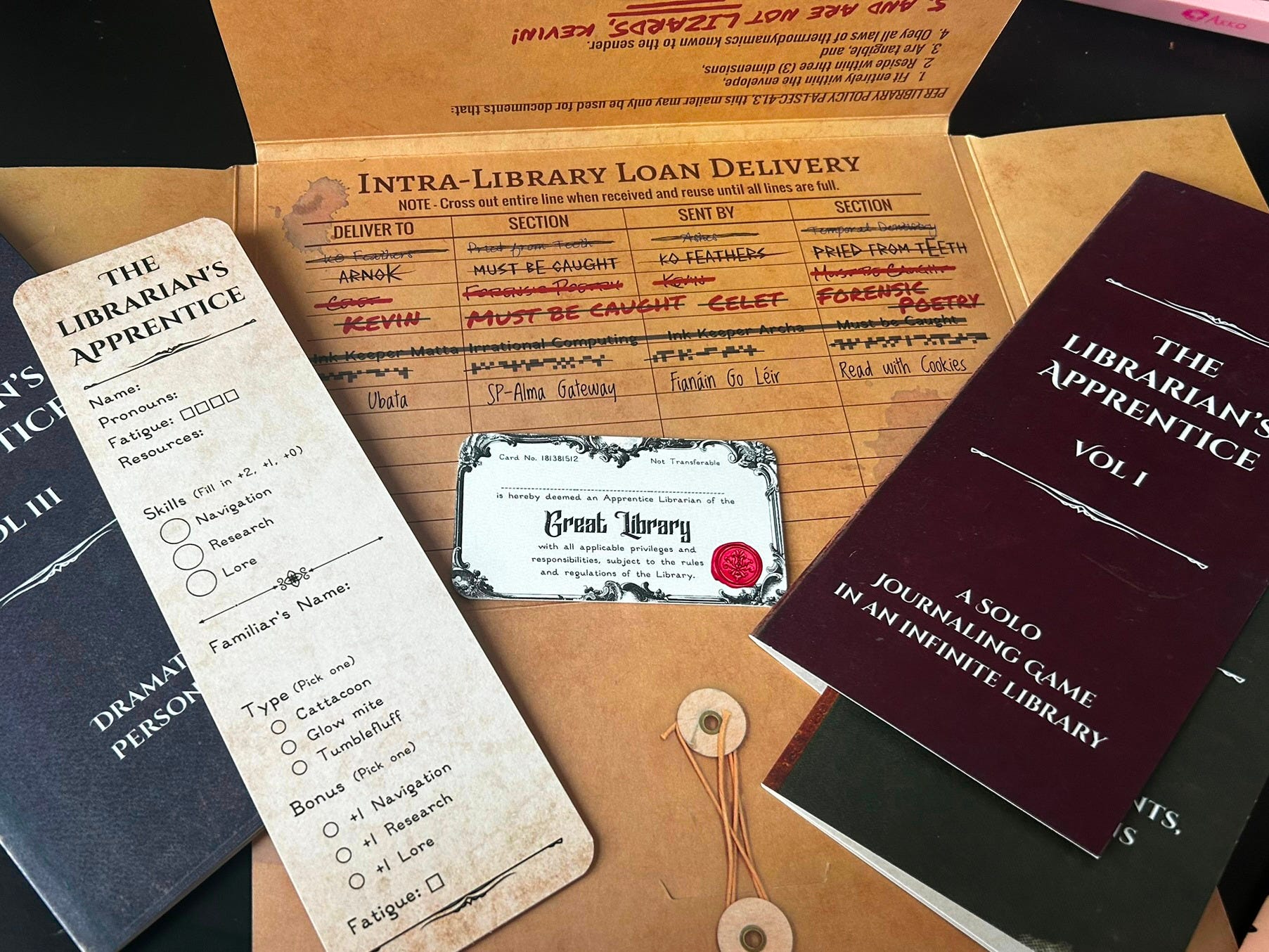
The Librarian’s Apprentice is based on Firelights SRD, which is a system that combines both the rolling of dice and drawing of cards together to create and overcome various narrative obstacles in your adventure. The Librarian’s Apprentice expands on this by adding a truly overwhelming amount of tables with various descriptors to allow you to create things on the fly. The rules are all distributed against 3 separate brochures, each marked as volume 1, 2 and 3. Volume one explains the game and character creation, whereas the other two serve as supplements to playing, helping flesh out the world around you.
Character Creation
To start with, you must create a character, along with defining a few ‘truths’ about the world, shaping your background and the setting of the story. You have three skills, where you’ll need to assign values of +2, +1, or 0:
Navigation - how well you are able to traverse the library and avoid complications;
Lore - how much knowledge do you have that will allow you to get yourself out of any mishaps caused by complications;
Research - how good are you at searching for resources that will help you on your journey;
You’ll also be able to create a familiar, a small creature to aid you on your quest - you can choose what type of creature it is, as well as what bonus it’ll be able to provide you with, which is a simple +1 to one of your rolls:
Cattacoon - part lemur, part raccoon, all trouble;
Glow Mite - crab-like automaton with glowing gems;
Tumblefluff - a library spirit in the form of a ball of dust the size of your little finger;
Once you have defined your character, you’ll need to choose one out of three options for each section : Your Background, Your Community, and Your Library. The combination of the answers allows you to define the world your adventure is set in, and sets some general themes as to what motivates you and keeps you in the library.
Playing the Game
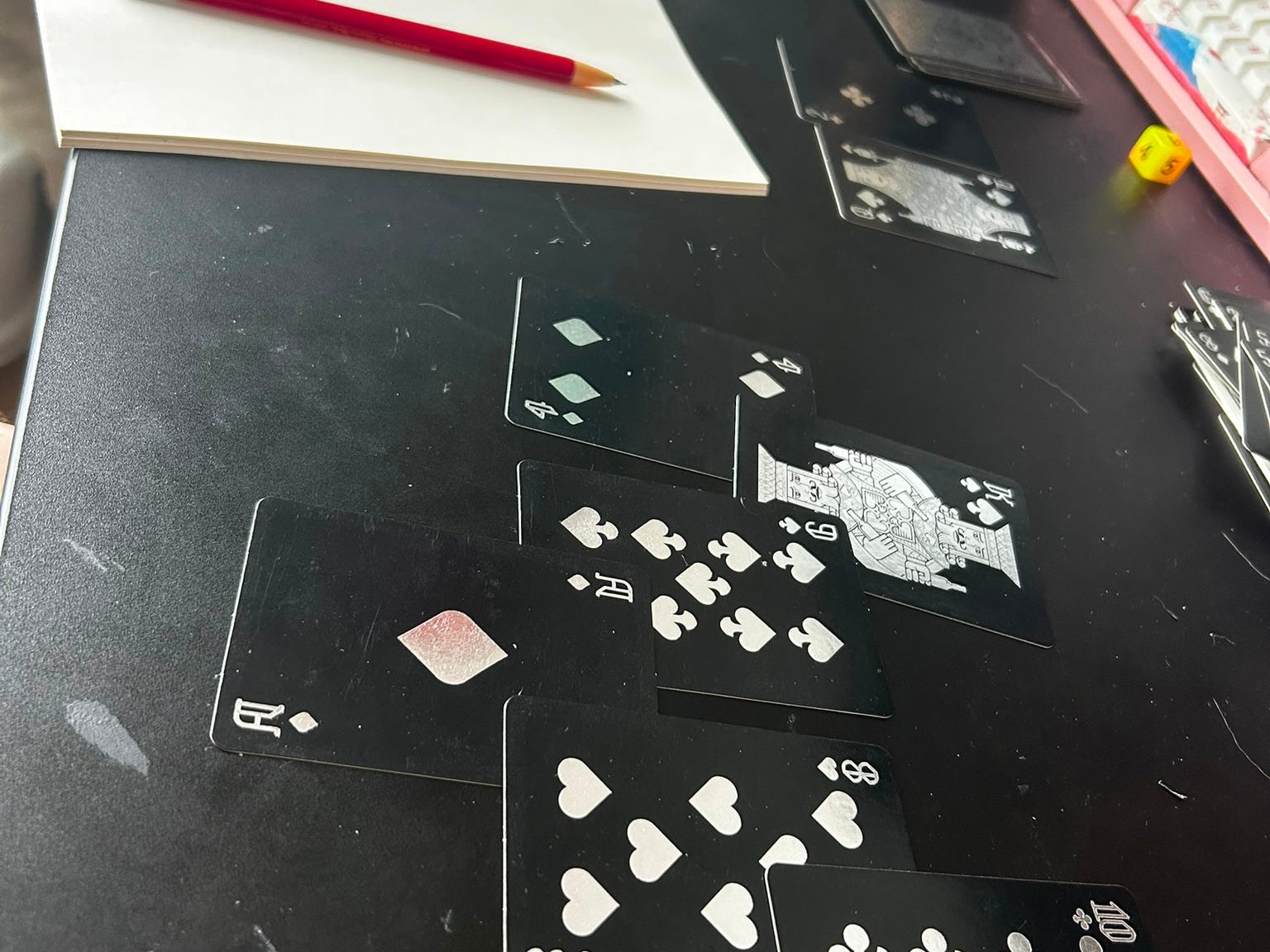
To play, you will use the cards to build a map of the library as you traverse it, as well as using them to define any target obstacles. You’ll have your starting point that is wherever your community currently lives, and the map serves as a way to tack your progress. Each action you perform is done by drawing two cards, rolling and summing 2D6, adding any applicable bonuses or modifiers, and then compare the score to the cards total. Any face card is counted at 11, and all aces are counted as 1. Results are split into three groups:
Light - score is higher than both cards;
Shadow - score is higher than one card;
Darkness - score lower than both cards;
You also have access to a mechanic called ‘Resources’ which is something you can discover via the action of performing research in each room. You accumulate cards, and can spend them in the following way:
1 resource - +1 to any action roll
3 resources - find a safe place to rest, clear all fatigue
5 resources - find one of the documents that you are seeking
It is also possible to ‘trade in’ cards in certain outcomes of actions: what the discarded card does, depends on the suit: clubs or spades are turned into a resource, and hearts or diamonds can be used to clear 1 fatigue.
The play loop is simple. You attempt to navigate to a room (roll + navigation). On a success of shadow or higher, you do so successfully. On darkness, you must deal with a complication in the room. Roll or choose from a series of tables to find some words to describe the room and features it has, the document formats stored within, and what kind of event or secret is hidden within. When all of that is resolved, if the card you drew is a face card, you find one of the documents you’re looking for, which moves you further towards your key objective of collecting 6 of them. You are then able to attempt to conduct some research in the room (roll + research) - on shadow or higher you can trade in a card, but on darkness, there is yet another complication, which you must deal with before leaving the room.
To deal with a complication (roll + lore), you need to pass a series of rolls to collect enough cards to match its difficulty value. On a roll of light, you get to add both cards to your complication stack. On a roll of shadow, you can pick one card, and mark 1 fatigue against your character. Darkness means you must discard both cards and mark 1 fatigue as well. Any card that matches the suit of where you are currently placed counts as two cards in the stack. Once the complication stack has the same amount or more as the complication number, discard the cards and consider it resolved.
Your overall goal is to collect 6 documents total for your librarian. It is possible for you to become too fatigued to continue, at which point you’ll have to abandon the search and return home. This counts as ‘finishing the game’, simply without achieving your objective.
My Experience of Play
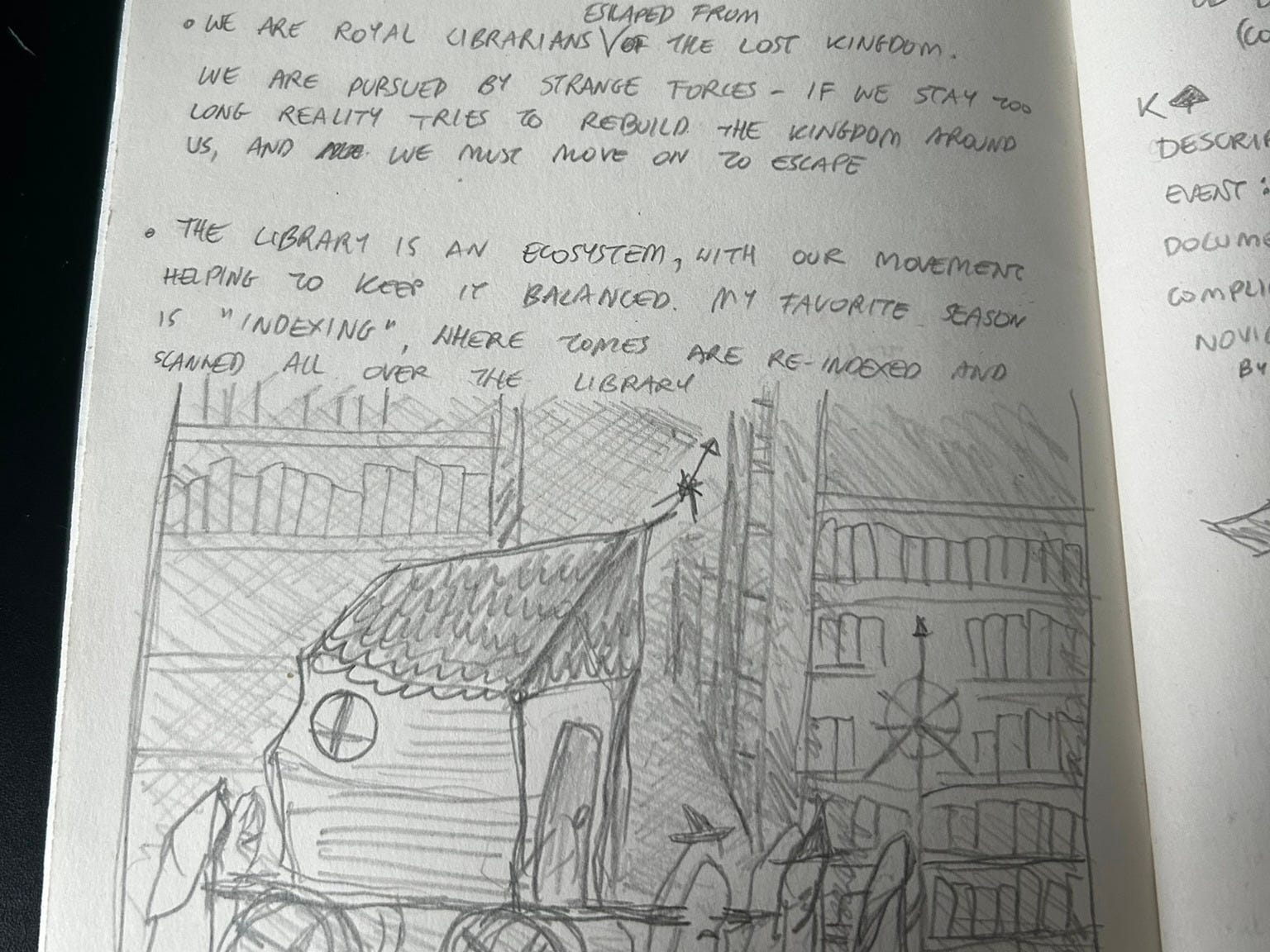
The first time I played The Librarian’s Apprentice, was before I had started the blog - unfortunately I haven’t kept the record of that, but I chose to write out longer journal entries. I had fun with it, but I found it very draining. I decided to take on a different approach this time, merely writing out the numbers but drawing bigger illustrations to capture the story that was unfolding in my head - mostly to practice my drawing a bit and to get ideas out of the way faster, and not linger on things that I didn’t find all that interesting.
To start with, I created my character Quill, who I decided was more crafty than he was smart (+2 lore, +1 navigation +0 research), with his trusty companion called Molly, a catacoon whose adventurousness got them out of trouble as often as it got them into it (+1 research).
Born and raised in the library, they were part of a group of travelling librarians, who had to keep moving every few months, as they had escaped a place called the ‘eternal kingdom’ which would start to wrap itself into reality around them if they ever stayed anywhere too long. As such, they wander the library, becoming part of its ecosystem and seasonality. Quill, being a novice, was assigned his first big task - to fetch six different documents to his mentor, Almanac, which will be used in helping the group navigate their course for the next season.
Setting out into the world, the first navigation roll did not go well (total of 3 vs the card total of 21). The first complication I encountered was a ‘a swarm of hungry books’ (difficulty : 8). However, I also bumped into the event of ‘novice researcher dealing with a complication’ which presented me with a good storytelling opportunity.
Novice Holdings, who was another one of Librarian’s Almanac students, has been cornered by the books, and curled up trying to survive the assault, clearly worse for wear with a few serious paper cuts. Quill’s primary issue wasn’t that he himself was being attacked, but trying to get Holdings out of his predicament. This took a few tries, and cost a fair amount of effort, but eventually both were safe and sound. Quill moved on to another room before the books decided to attack again.
The second room yet again was going to include a complication. My roll was much better this time, a solid total of 9, but the cards I drew were both 10s, meaning that more mayhem was on the way. The complication was ‘an intruder’ ( difficulty: 5) which wasn’t going to be anywhere near as bad as the angry books, but still requiring some level of challenge.
I looked through the booklets and rather than creating a character of my own, I leant into one of the listed patrons in the volume 3 - Menry, a playful trickster looking for various ways to fool gullible people. For a bit of comedy, I decided he was quite literarily trying to sell snake oil to the main character rather than pose a serious threat. It was simply the problem of trying to avoid someone very, very insistent.
There are fewer things more uncomfortable than being confronted with a man who treats the phrase ‘no thank you’ as encouragment to keep trying rather than giving up. Menry wasn’t a difficult obstacle on anyone’s journey due to his prowess or cunning, but merely because of his persistence.
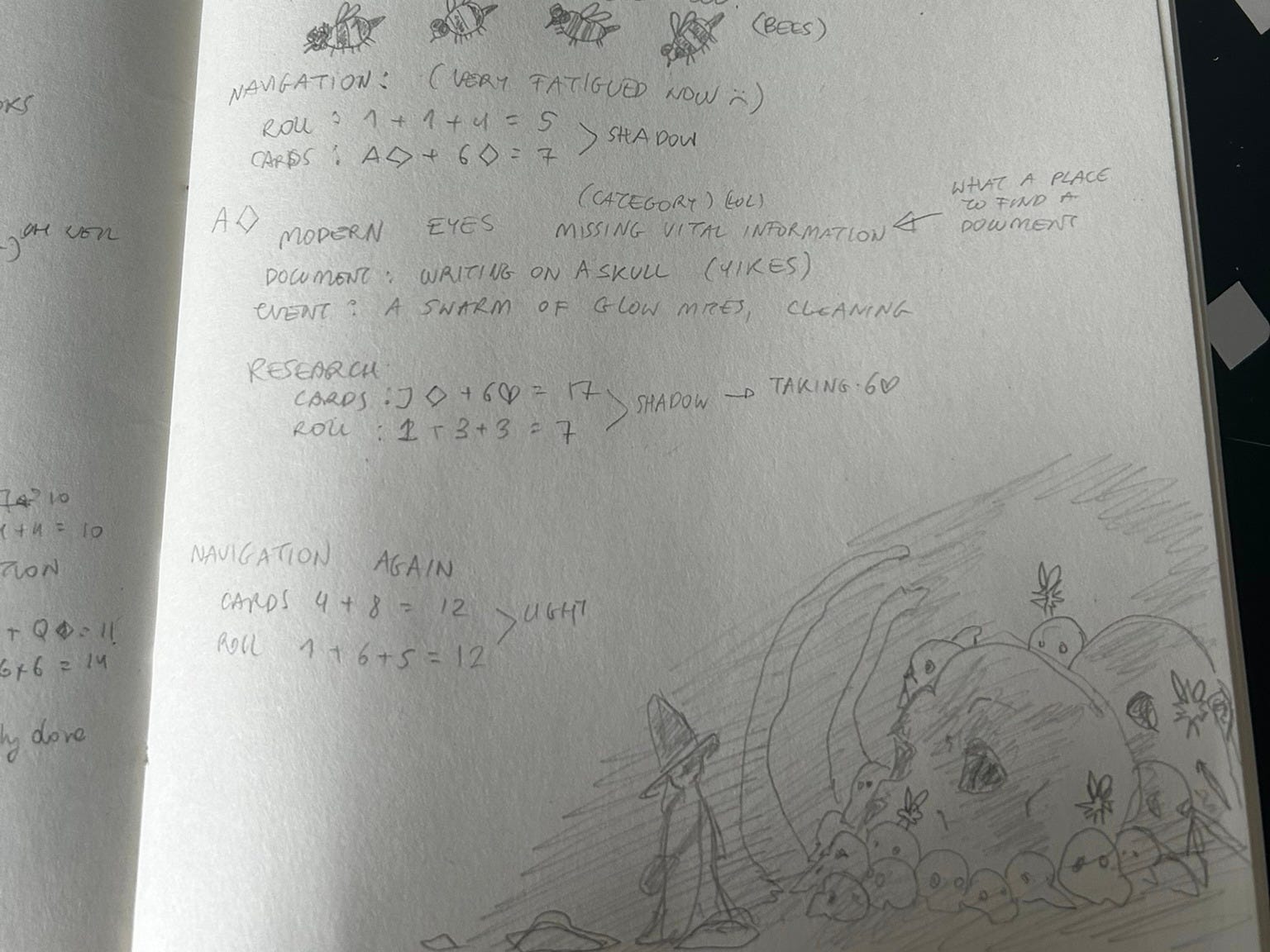
The following room looked to be smoother scaling, but the mood got a lot more somber - the tags for the room description was “eyes”, with records of “missing vital information”, where the information itself was stored in writing on various skulls - a bit of a thematic whiplash from the previous space, but I really liked the visual that had formed in my head, so I kept going with it, and did a sketch of a pile of skulls - some small, some large and all with various levels of humanity, plus a few ribs sticking out around it for good measure. It was one of the rooms in which I found one of the documents that I was looking for, which made it even more interesting.
I felt emboldened by my success so far and decided to try and try some researching - unfortunately this was marred by another low roll, and more consequences rolled in - this time the theme was “a librarian who will test you” - and I decided that was simply Novice Holdings reappearing and simply being a really annoying presence that tests the patience of Quill.
I was starting to feel exhausted by this point - drawing and thinking are activities that require a fair amount of focus, and I could feel I was starting to really struggle with it. I took a break for a few hours and returned later in the day. Quill didn’t have much energy left at this point (only one free fatigue box remaining, plus the one on his familiar), and not enough resources to try and recover any of it. I figured we could both use a bit of a break from this.
Getting back took a little time, as I had to put the cards back to how they were to represent the map and gather all the other bits and bobs, but it had a nice, almost ritualistic aspect to getting set back up again. Once ready, I drew more cards and attempted to so some navigation again - I did exceedingly well this time, being able to match the total of the two cards I drew. The room itself was a bit more abstract, as the keywords I got were ‘upper’, ‘eyes’ and ‘star chart’ - and the documents being the ‘melody of fire’. I decided to interpret that as the twinkling of the stars in the animated map chart being what contains the information stored in this room, with a massive, expansive sky of various unreal constellations. I tried to research again (rolled a total of 6, with the cards total being 22), at this point actively tempting fate, and I did get a complication - encountering ‘a keeper of the forbidden’. I chose to create a creature with that name:
A giant ghostly figure made out of long shadowy hands that picks up books from dead bodies in the library and places them back where they belong - it tends to be an omen of ill fate, but it does not actively attempt to attack or interfere with anyone, unless they are about to die - it simply wants the books back.
I was able to resolve the conflict pretty quickly, as the difficulty wasn’t very high (5). Still, it did cost me the fatigue of my familiar, which made me quite sad - even though I’ve made no effort to include it in the story at all, I always struggle with having to offload the potential negative consequences this way. I’d rather end the game early than do so, sometimes.
I knew I was nearing the end, and at this point I’d only found two documents, so unless I was going to magically get better at research, it was very unlikely that I would succeed in my task. Still, I carried on, mostly spurred on by the desire to see more of the room prompts combine to give me some nice evocative images. The final room I encountered had a lost patron who was trying to find any kind of exit - I decided it would be another of the suggested patrons suggested by the book, Blance Henbury, who believes that they’re simply in a quaint used bookshop across from the deli. It was also a nice way to introduce a complication that I knew I was going to fail - as I wanted to invest the time and effort into at least helping her move to a part of the library that she did want to go to, without trying to convince her otherwise. It made of a nice resolution to when I did lose more fatigue - I did help an old lady find her way to where she needed to go, but the experience left me simply too tired to continue the search of the day, needing to return home.
What I Really Liked
I really enjoyed just how varied and evocative the world of The Librarian’s Apprentice is - with a set of over 216 (3x6x6 total!) descriptors for every single room, there are some truly mesmerising combinations out there. I also liked the challenge of making them work - the first time I played the game, I encountered the room that had the description of “organic” and “gambling” which I chose to interpret as some kind of living organism out of which various machines grew out of like one-armed bandit and which was a known and popular spot amongst the denizens of that library, despite its weirdness.
The usage of cards that dynamically created various difficulty levels to meet was something that I really enjoyed mechanically, making each choice matter, and potentially spiral down into further problems. I found myself enjoying the system, despite being originally quite worried I’d find all the mechanics too overwhelming.
What I Would Change
Fundamentally, The Librarian’s Apprentice seems to be a game designed for longer play, with multiple sessions over time. Given that isn’t really how I tend to play, or how irregular my time to play, it can make things difficult to know what’s been happening if you put it down for a prolonged period of time. Even with a break of a few hours in the same day, it can take a second to restart, especially if you clean up your environment in between. The mapping idea, while fresh and novel, can take up quite a lot of desk space, and seems to be mostly there for the visual rather than all that much functionality.
I also wish that the complications table had been expanded, as it’s probably the smallest one of all - with merely 12 different events. A player isn’t necessarily meant to encounter as many as I did all at once, but it’d be nice to see just as much creativity there as with all the prompts and keywords available both to character creation and the room designs.
Final Thoughts
Overall, I enjoyed each of my walk-throughs with the Librarian’s Apprentice, although each time I found it quite difficult to keep my attention and focus on the game. It’s simply a longer and more meaty game than I’m normally used to, and that is certainly reflected in my experience. I certainly would play it again, and with taking longer breaks in between each session it became much more pleasant, rather than trying to force myself to be more creative.
I also really enjoyed a game that has an explicit failure state for me, such as simply not being able to complete the task of collecting all documents - which I still have yet to complete successfully. Not only that, but I found that the complications can be quite a drain and somewhat spur on more and more misfortune - which, to me, was a pretty great thing, as it pushed the fiction forward. There are certainly worse ways to end a game, and the stakes still stayed low enough that I didn’t feel like I was actually loosing anything at all.
I think I’ll hold on to this copy for a long time, and probably use the volumes one and two as a way to help me generate rooms in other stories - even purely on its own it is a very evocative resource for building characters on the fly, and I’d happily look for an opportunity to use some of the more obscure prompt combinations in other games.
I really enjoyed reading your review. Thank you so much for sharing your play and thoughts!